Top Flooring Trends in Cape Town for 2026: What Homeowners Are Choosing
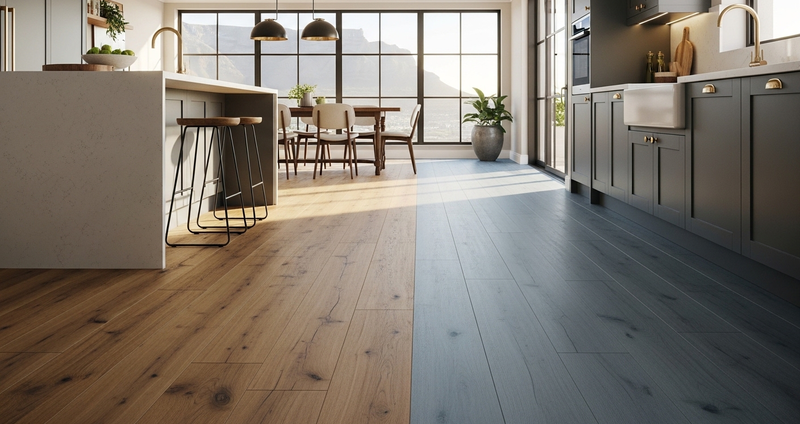
Flooring trends in Cape Town for 2026 are shifting toward warm, natural, and highly durable materials that offer both comfort and sustainability. The trend moves away from cool, monochromatic greys in favor of earthy tones, rich textures, and patterned layouts that add character to homes.
Key Takeaways: Flooring Trends in Cape Town
-
-
- Large-format porcelain tiles (900x900mm and larger) are taking over Cape Town interiors in 2026, creating seamless, spacious looks that work in both modern and traditional homes.
- Engineered wood flooring is rapidly replacing solid hardwood as Cape Town’s coastal humidity makes solid wood floors prone to warping and cupping — engineered wood handles these conditions far better.
- Warm earthy tones like beige, taupe, and sand are officially replacing cold grey floors, reflecting a broader shift toward natural, grounded interiors that complement Cape Town’s stunning natural surroundings.
- Luxury Vinyl Plank (LVP) is no longer just the budget option — in 2026, it’s a genuine design choice offering waterproofing, durability, and realistic wood and stone looks at a fraction of the cost.
- Sustainability is shaping flooring decisions more than ever, with bamboo, reclaimed wood, and low-VOC products becoming priorities for Cape Town homeowners who care about the environment as much as aesthetics.
-
Cape Town Floors Are Getting a Major Upgrade in 2026
The floors beneath your feet say more about your home than almost anything else — and in 2026, Cape Town homeowners are finally treating them that way.
The trends shaping flooring right now aren’t just about looks. They’re about performance in Cape Town’s unique coastal climate, long-term value, and materials that feel authentic rather than mass-produced. Whether you’re renovating a Sea Point apartment, updating a Constantia family home, or fitting out a new build in Bloubergstrand, the flooring choices available in 2026 are smarter, more beautiful, and more practical than they’ve ever been. LT Cape Flooring has been tracking these shifts closely, and the direction is clear — homeowners want floors that last and look incredible doing it.
What’s driving these changes? A combination of global design influences filtering into the South African market, growing awareness of product quality differences, and a post-pandemic desire to invest meaningfully in the home. The result is a Cape Town flooring market that’s more sophisticated, more considered, and far more exciting than it was even two years ago.
1. Large-Format Porcelain Tiles Are Dominating Cape Town Interiors
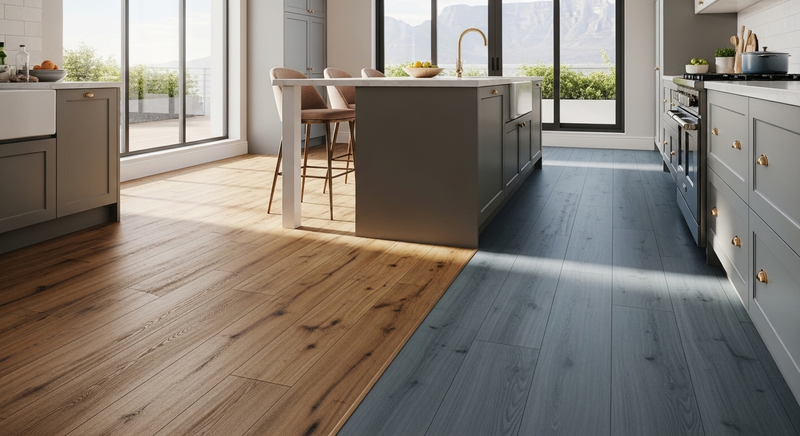
If you’ve walked into any newly renovated Cape Town home in the last twelve months, you’ve almost certainly noticed the tiles getting bigger. Large-format porcelain — typically starting at 600x600mm and increasingly running to 900x900mm, 1200x600mm, or even full slab sizes — has become the defining floor choice of 2026.
Quick Format Guide: Large-Format Porcelain Tile Sizes
Tile Size Best Application Visual Effect 600x600mm Smaller rooms, bathrooms Clean, modern look 900x900mm Open-plan living areas Spacious, seamless feel 1200x600mm Large kitchens, lounges Dramatic, high-end finish 1200x1200mm+ Luxury interiors, extensions Hotel-grade visual impact
The appeal isn’t just visual. Fewer grout lines mean less cleaning, less maintenance, and a floor surface that holds up better over time in high-traffic areas. For Cape Town homes that deal with sandy feet from beach days and muddy paws from mountain walks, that’s a genuinely practical advantage.
Why Bigger Tiles Make Rooms Look Larger
Fewer grout lines mean the eye travels further without interruption, which makes any space feel more open. In a compact Sea Point flat or a mid-sized Claremont home, this visual expansion is significant. When large-format tiles are laid in a continuous run from the living area into an open kitchen, the effect is close to seamless — the room reads as one large, unified space rather than a collection of sections.
The choice of finish matters too. A matte or satin finish in a warm neutral tone amplifies the spacious feeling without creating glare, which is particularly relevant in homes with Cape Town’s abundant natural light flooding through north-facing windows.
Best Rooms to Use Large-Format Porcelain in Cape Town Homes
Large-format porcelain works hardest in open-plan living and kitchen areas, entrance halls, and main bathrooms. These are the rooms where the visual impact is greatest and the practical benefits — durability, water resistance, and ease of cleaning — matter most. In South African homes, where indoor-outdoor living is a lifestyle staple rather than a design trend, large-format tiles on the interior that flow out to a tiled patio create a cohesive connection between spaces that feels genuinely luxurious.
Natural Stone Looks Without the Natural Stone Price
One of the biggest drivers of the large-format porcelain trend is the technology behind it. Modern porcelain manufacturing has reached a point where the surface texture, veining, and tonal variation of materials like Carrara marble, travertine, and slate are replicated with remarkable accuracy. You get the visual richness of natural stone with none of the sealing requirements, staining vulnerability, or price tag.
Brands available through South African suppliers are producing large-format porcelain tiles that genuinely challenge the eye — pieces with natural variation, subtle texture, and depth that makes them feel like the real thing underfoot and overhead.
Porcelain vs. Natural Stone: A Practical Comparison for Cape Town Homes
Feature Natural Stone Large-Format Porcelain Cost High Moderate to High Maintenance Regular sealing required Minimal — no sealing needed Stain Resistance Moderate (porous) Excellent (non-porous) Durability Good but chips possible Very high scratch resistance Aesthetic Range Natural variation only Marble, slate, travertine & more Installation Complexity High Moderate (requires flat substrate)
2. Engineered Wood Flooring Is the Smarter Choice Over Solid Hardwood
There’s a reason engineered wood flooring has surged in popularity across Cape Town — and it has everything to do with the city’s climate. Cape Town’s coastal position means homes regularly experience humidity fluctuations, salt air, and temperature swings between seasons that can be brutal on solid timber floors.
How Cape Town’s Coastal Climate Affects Solid Wood Floors
Solid hardwood is made from a single piece of timber. When moisture levels rise — which they do consistently in Cape Town’s wet winters and coastal summer evenings — solid wood absorbs that moisture and expands. When the air dries out, it contracts. This repeated movement causes cupping, warping, and gapping over time. In suburbs close to the ocean like Camps Bay, Green Point, and Bloubergstrand, these issues appear faster and more severely than they would in an inland city.
Why Engineered Wood Handles Humidity and Temperature Changes Better
Engineered wood is constructed differently. A real hardwood veneer sits on top of multiple cross-directional layers of high-density plywood or HDF core. Because these layers are bonded with their grain running in alternating directions, the board resists the expansion and contraction that destroys solid timber. The result is a floor that looks and feels like genuine hardwood — because the surface layer is genuine hardwood — but performs far more reliably in Cape Town’s conditions.
Brands like BOEN, which are stocked by quality Cape Town flooring suppliers, produce engineered boards with wear layers thick enough to be sanded and refinished multiple times over the life of the floor. A 3mm or 4mm hardwood wear layer means the floor can be refreshed rather than replaced — a significant long-term cost saving for homeowners investing in quality.
3. Neutral and Earthy Tones Are Replacing Cold Greys
Grey floors had a remarkable run. For the better part of a decade, grey-toned tiles, grey-washed vinyl, and grey-stained laminate dominated South African homes. In 2026, that era is firmly over.
The Shift From Grey to Warm Beige, Taupe, and Sand Tones
The palette shift happening in Cape Town interiors right now is toward warmth — specifically beige, warm taupe, sand, terracotta, and soft ochre tones. These colours don’t clash with Cape Town’s natural environment; they echo it. The warm sandstone of the Boulders Beach area, the fynbos tones of the Cape Peninsula, the bleached timber of coastal dunes — these are the colours that Cape Town’s most current interiors are drawing from.
Flooring in these tones creates a visual warmth that grey simply couldn’t deliver. A room with a warm beige porcelain floor or a honey-toned engineered oak board feels inviting, grounded, and connected to the natural world outside — which is exactly where interior design is heading in 2026.
How Earthy Floors Complement Cape Town’s Natural Surroundings
Cape Town is one of the most visually dramatic cities in the world. The Twelve Apostles mountain range, the Atlantic seaboard, the indigenous fynbos — the natural environment here has a colour palette that’s impossible to ignore. Warm-toned floors work in harmony with that environment rather than against it, creating interiors that feel like a natural extension of the landscape outside the window.
A sandy beige porcelain tile in an open-plan Hout Bay home, for example, draws the eye seamlessly from the interior to a timber deck and the mountain beyond. A warm taupe engineered oak board in a Newlands cottage echoes the earthy tones of the Constantiaberg forest without a single piece of decor needing to do that heavy lifting. The floor sets the tone for everything above it — and in 2026, that tone is warm, natural, and deeply connected to place.
Pairing Warm Floors With Modern and Minimalist Interiors
One concern homeowners raise about warm-toned floors is whether they’ll clash with a modern, minimalist aesthetic. The answer is firmly no — in fact, warm neutrals ground minimalist interiors better than cool greys ever did. A white-walled, clean-lined kitchen with warm beige porcelain underfoot feels sophisticated and liveable. The same kitchen with a cool grey floor can tip into feeling clinical. In 2026, the combination of warm floors with simple, considered furniture and matte black or brushed brass hardware is the interior look defining Cape Town’s most aspirational homes.
4. Luxury Vinyl Plank Is the Practical Trend Nobody Is Ignoring
Luxury Vinyl Plank — LVP — has had a reputation problem in the past. It was seen as the budget fallback when timber or tile wasn’t affordable. That perception has shifted dramatically. In 2026, LVP is a genuine first-choice flooring option for Cape Town homeowners who prioritise performance and want realistic wood or stone looks without the limitations of natural materials. For more insights on interior design, check out interior design trends for 2026.
Water Resistance Makes It Ideal for Cape Town’s Wet Winters
Cape Town’s winters are wet — genuinely wet. The city averages over 500mm of rainfall annually, with most of it concentrated between June and August. In homes where wet feet, damp umbrellas, and moisture tracked in from outside are daily realities, a fully waterproof floor isn’t a luxury — it’s a necessity. LVP is 100% waterproof throughout its entire construction, not just at the surface. Where laminate will swell and bubble if water penetrates the joints, quality LVP holds up without issue. For kitchens, laundry rooms, bathrooms, and open-plan areas that connect to the outdoors, this is a significant practical advantage.
How Luxury Vinyl Plank Compares to Laminate in 2026
Laminate flooring has a wood-effect surface layer bonded to a high-density fibreboard core. It can look convincing, but the HDF core means moisture is its weakness. Drop water on a laminate floor repeatedly and the boards will eventually warp, swell, and lift at the edges. LVP, by contrast, is built on a PVC or stone-plastic composite (SPC) core that doesn’t react to water at all. SPC-core LVP also has a denser, harder feel underfoot that more closely mimics the solidity of a real timber or tile floor.
The wear layer is the other critical difference. Budget laminate has a surface that shows scratches and wear within a few years in a busy family home. Quality LVP products feature wear layers of 0.5mm (20 mil) or thicker — enough to handle pets, children, and heavy furniture movement without showing significant surface damage over a realistic product lifespan.
Best Areas in the Home to Install Luxury Vinyl Plank
LVP performs exceptionally well in any room where moisture, traffic, or practical demands rule out softer or more vulnerable flooring materials. In Cape Town homes specifically, the strongest use cases are kitchens, open-plan living areas, children’s bedrooms, and any room with direct access to an outdoor space.
Bathrooms are another area where LVP has made serious inroads. A well-chosen LVP product in a warm timber look transforms a bathroom from purely functional to genuinely warm and designed — something that large-format porcelain achieves differently, but that LVP pulls off with a cosiness that tile can’t match.
One space that’s particularly relevant for Cape Town homes is the braai room or entertainment area. These spaces experience heavy foot traffic, food and drink spills, and often connect directly to outdoor paving. LVP handles all of this without complaint, making it one of the smartest flooring choices for the South African lifestyle specifically.
5. Textured and Tactile Finishes Are Replacing Flat and Glossy Surfaces
High-gloss floors are fading fast. The move toward matte, brushed, and textured surface finishes is one of the most consistent design signals in the 2026 flooring market — and it makes complete practical and aesthetic sense for Cape Town homes.
Why Matte and Brushed Finishes Are Trending
Glossy floors show everything — footprints, dust, smears, pet marks. In a Cape Town home where life is lived fully and floors take a beating, maintaining a high-gloss surface to a standard that actually looks good requires constant effort. Matte and satin finishes are far more forgiving. Marks that would be immediately visible on a polished surface are absorbed into the texture of a matte floor, meaning the floor looks good between cleans rather than only immediately after them.
Beyond practicality, there’s a strong aesthetic case. Matte and brushed finishes feel more natural, more tactile, and more authentic. A brushed oak engineered board with a lightly textured surface feels like real wood in a way that a high-gloss laminate plank never could. The texture invites touch, creates depth, and catches light in a way that flat surfaces simply don’t. In 2026, that authenticity is exactly what Cape Town homeowners are looking for.
How Textured Floors Add Depth to Open-Plan Living Spaces
Open-plan living is the dominant layout in contemporary Cape Town homes, and textured floors play a specific role in making these large, undivided spaces feel visually interesting rather than flat. When light — especially Cape Town’s intense, directional afternoon sun — travels across a textured floor surface, it creates subtle shadow and variation that adds dimension to the space. A smooth, glossy floor reflects that same light uniformly and can feel harsh. A hand-scraped engineered board or a slightly textured matte porcelain tile turns Cape Town’s extraordinary natural light into a design feature.
6. Patterned Tiles Are Making a Bold Comeback
- Encaustic cement tiles with geometric or floral patterns are appearing in Cape Town kitchens, bathrooms, and entrance halls as feature floors
- Zellige-inspired ceramic tiles with handmade variation and irregular surface texture are bringing an artisanal quality to contemporary interiors
- Bold black-and-white geometric patterns are being used as statement floors in compact spaces where they create visual drama without overwhelming the room
- Terracotta-toned patterned tiles are connecting contemporary Cape Town homes to a Mediterranean and North African aesthetic that suits the Mother City’s climate and culture
- Chevron and herringbone layouts in both tile and plank formats are adding pattern through installation technique rather than surface design — a subtler approach that works in more spaces
The return of patterned tiles isn’t a nostalgic retreat — it’s a confident design choice. After years of minimalism dominating Cape Town interiors, homeowners are ready to introduce character and personality through their floors, and patterned tiles are one of the most effective ways to do it. A patterned floor is the equivalent of a statement piece of furniture — it defines the room, creates a mood, and does work that plain walls and neutral upholstery can’t.
The key to making patterned tiles work in 2026 is restraint in application. The trend is for one strong patterned floor in a home — an entrance hall, a bathroom, a kitchen splashback-to-floor transition — rather than pattern throughout. This creates a moment of visual impact that feels intentional rather than overwhelming. The rest of the home’s flooring remains calm and neutral, which makes the patterned space feel even more striking by contrast.
Cape Town’s design culture — shaped by its position at the intersection of African, European, and Asian influences — makes it a particularly natural home for this trend. Patterns drawn from Moroccan tilework, Portuguese azulejos, Cape Malay geometric traditions, and contemporary Scandinavian design are all appearing in Cape Town interiors right now, often in unexpected and beautiful combinations that feel genuinely local rather than imported.
Encaustic and Geometric Tiles in Modern Cape Town Homes
Encaustic cement tiles — made by pressing pigmented cement into moulds rather than firing them in a kiln — have a surface texture and colour depth that ceramic tiles can’t replicate. They’re slightly porous, which means they require sealing, but the visual result is worth the maintenance consideration. In a Cape Town home with whitewashed walls, timber furniture, and indoor plants, an encaustic tile floor in a warm geometric pattern creates an interior that feels both contemporary and deeply rooted in craft. The handmade quality — the slight variation in colour and pattern from tile to tile — is precisely the point. It’s the opposite of mass production, and in 2026, that authenticity is what Cape Town’s most design-conscious homeowners are seeking.
Where to Use Patterned Tiles Without Overwhelming a Space
The entrance hall is the single best place to introduce a bold patterned tile in a Cape Town home. It’s a space that every visitor passes through, it sets the tone for the entire interior, and it’s small enough that a strong pattern feels exciting rather than exhausting. A geometric encaustic tile in terracotta and cream in an entrance hall, paired with whitewashed walls and a simple timber console, creates an arrival moment that feels curated and confident. From there, the rest of the home can breathe in calmer, more neutral tones.
7. Sustainable Flooring Materials Are Becoming a Priority
Cape Town homeowners have always had a strong connection to the natural environment — you don’t live in the shadow of Table Mountain without developing one. In 2026, that connection is translating directly into flooring decisions. Sustainability is no longer a bonus consideration; for a growing segment of the Cape Town market, it’s a baseline requirement.
The demand is being driven by both values and awareness. Homeowners are asking harder questions about where their flooring comes from, how it’s manufactured, what it’s made of, and what happens to it at end of life. Suppliers who can answer those questions clearly — with certifications, chain-of-custody documentation, and transparent sourcing — are winning business over those who can’t. The products themselves are also improving rapidly, meaning the sustainable choice no longer requires any aesthetic or performance compromise.
Bamboo and Reclaimed Wood as Eco-Friendly Alternatives
Bamboo flooring is one of the most genuinely sustainable options available in 2026. Bamboo is technically a grass, not a timber, and it reaches harvestable maturity in three to five years — compared to the decades required for most hardwood species. Strand-woven bamboo, the densest and most durable form, is harder than most traditional hardwoods by Janka hardness rating and handles foot traffic exceptionally well. It’s available in a range of tones from pale natural through to deep carbonised, and it works beautifully in Cape Town homes where a timber aesthetic is desired without the environmental cost of slow-growth hardwood.
Reclaimed wood flooring takes a different approach — rather than growing new material, it recovers timber from demolished buildings, old warehouses, decommissioned railway sleepers, and salvaged structures. The result is flooring with genuine history written into it: nail holes, saw marks, colour variation, and grain patterns that no new timber can replicate. In Cape Town, where heritage architecture and contemporary design regularly intersect, reclaimed wood floors create interiors with real depth and story. The environmental benefit is significant too — no new trees harvested, no manufacturing energy beyond the milling and finishing process.
Sustainable Flooring Options: A Quick Comparison
Material Sustainability Factor Durability Aesthetic Best For Strand-Woven Bamboo Rapidly renewable (3–5 years) Very high Clean, modern timber look Living areas, bedrooms Reclaimed Wood Zero new harvesting High (species-dependent) Rich, characterful, unique Feature rooms, heritage homes Cork Harvested without felling trees Moderate Warm, textural, natural Bedrooms, home offices Low-VOC Engineered Wood FSC-certified options available Very high Genuine hardwood surface Whole-home installation Recycled Content LVP Uses post-consumer recycled material High Wood or stone look Wet areas, high-traffic zones
Cork is another sustainable option gaining renewed attention in 2026. Harvested by stripping bark from cork oak trees — a process that doesn’t harm or kill the tree and can be repeated every nine years — cork flooring offers a warm, slightly cushioned surface that’s naturally antimicrobial, thermally insulating, and acoustically absorbent. For Cape Town homeowners with young children, home offices, or top-floor apartments where sound transmission to lower floors is a concern, cork delivers practical benefits that go well beyond its environmental credentials.
What to Look for in Environmentally Responsible Flooring Products
Sustainability claims in the flooring industry range from genuinely robust to essentially meaningless marketing. Knowing which certifications and product characteristics actually indicate responsible manufacturing helps Cape Town homeowners make decisions they can feel confident about rather than just good about.
The most reliable indicators of genuine sustainability in a flooring product are third-party certifications and independently verified standards — not brand claims on packaging. When assessing a flooring product’s environmental credentials, look for the following:
- FSC Certification — Forest Stewardship Council certification confirms that timber was harvested from responsibly managed forests with verified chain-of-custody documentation
- Low VOC or Zero VOC ratings — Volatile Organic Compounds off-gas from adhesives, finishes, and core materials; low-VOC products protect indoor air quality, which is particularly important in well-sealed modern homes
- GREENGUARD Gold Certification — An independent certification confirming that a product meets strict chemical emissions standards for indoor air quality
- Recycled content percentage — Products that incorporate post-consumer or post-industrial recycled material reduce the demand for virgin resources
- End-of-life recyclability — Some LVP and composite products are now manufactured to be recyclable at end of product life rather than going to landfill
- Local manufacturing or sourcing — Products manufactured or sourced closer to South Africa carry a lower transport carbon footprint than those shipped from distant markets
The simplest practical approach is to ask your flooring supplier directly for certification documentation rather than accepting general sustainability claims at face value. Reputable Cape Town flooring suppliers stocking quality international and local brands will be able to provide this information without hesitation.
The Flooring Trend Worth Investing in for Your Cape Town Home
Every trend covered in this guide points in the same direction: away from cheap, disposable flooring and toward materials that perform beautifully, age gracefully, and genuinely enhance the way Cape Town homes look and feel. Whether that means large-format porcelain that makes your living room feel twice its size, engineered oak that handles coastal humidity without warping, or a bold encaustic entrance tile that makes arriving home feel like a design moment — the investment is worth making once and making well. The floors you choose in 2026 will define your home for the next decade, and with the quality of products now available in the Cape Town market, there’s no reason to settle for anything less than exceptional. LT Cape Flooringspecialises in helping Cape Town homeowners navigate these choices with expert guidance and quality installation across all the materials and trends shaping 2026.
Frequently Asked Questions About Flooring Trends in Cape Town
Cape Town homeowners renovating or building in 2026 are asking sharper, more specific questions about flooring than ever before. The answers below cut through the general advice to address what actually matters for homes in this specific city, climate, and lifestyle context.
From durability in high-traffic family homes to the real costs of installation and which materials handle Cape Town’s coastal conditions best, these are the questions that come up most often — answered directly and practically.
What Is the Most Durable Flooring Option for Cape Town Homes in 2026?
For overall durability across the widest range of Cape Town home environments, large-format porcelain tile and SPC-core Luxury Vinyl Plank are the top performers in 2026. Porcelain rates between 7 and 8 on the Mohs hardness scale — harder than most natural stones — and is essentially impervious to scratching, staining, and moisture damage when correctly installed. SPC-core LVP with a 0.5mm (20 mil) or thicker wear layer delivers exceptional resistance to scratching, denting, and water damage in a format that’s warmer and more comfortable underfoot than tile. For timber aesthetics specifically, engineered wood with a thick hardwood wear layer offers excellent long-term durability when properly maintained and is the most durable wood-look option suited to Cape Town’s humidity levels.
Is Engineered Wood Flooring Suitable for Cape Town’s Coastal Climate?
Yes — engineered wood is specifically the right timber flooring choice for Cape Town’s coastal climate, and it outperforms solid hardwood in these conditions consistently. The cross-directional plywood or HDF core construction resists the expansion and contraction caused by humidity fluctuations, which are a daily reality in suburbs like Sea Point, Camps Bay, Bloubergstrand, and Green Point. Solid hardwood in these locations is genuinely vulnerable to cupping and warping within a few years; quality engineered boards handle the same conditions without structural movement. The key specifications to look for are a minimum 3mm hardwood wear layer — which allows for sanding and refinishing — and a core construction that uses a minimum of five plywood layers for maximum dimensional stability.
How Much Does It Cost to Install Luxury Vinyl Plank Flooring in Cape Town?
LVP pricing in Cape Town in 2026 varies based on product quality tier, wear layer thickness, installation method, and subfloor preparation requirements. As a general guide:
- Entry-level LVP (0.3mm wear layer) — R150 to R250 per square metre for product only; suitable for low-traffic bedrooms and light domestic use
- Mid-range LVP (0.5mm / 20 mil wear layer) — R300 to R500 per square metre for product only; the recommended minimum for family homes and open-plan areas
- Premium SPC-core LVP (0.7mm+ wear layer) — R500 to R800+ per square metre for product only; commercial-grade performance for demanding domestic environments
- Installation labour — typically R80 to R150 per square metre depending on installation complexity and subfloor condition
- Subfloor preparation — self-levelling compound and preparation work adds cost if the existing subfloor is uneven; LVP requires a flat surface to within 3mm over 1.8 metres for correct installation
The total installed cost for a quality mid-range LVP in a typical Cape Town home generally falls between R400 and R700 per square metre inclusive of labour, subfloor preparation, and underlay where required. This positions quality LVP significantly below engineered hardwood and large-format porcelain on a per-square-metre installed basis, while delivering waterproof performance that neither of those options can fully match.
It’s worth noting that the cheapest LVP products on the market carry meaningful risk. Thin wear layers — anything below 0.3mm — show surface wear within two to three years in a busy household, and budget products often have dimensional instability issues that cause gapping and lifting at joints over time. The mid-range and premium tiers represent genuinely better value over a ten-year ownership horizon than entry-level products that may need replacing within five years.
Always request a full installed quote from your Cape Town flooring supplier that includes subfloor assessment, underlay, installation, and finishing trim — the product price alone rarely tells the complete cost story.
What Flooring Works Best in High-Traffic Areas of a Cape Town Home?
Entrance halls, kitchens, and open-plan living areas that connect to outdoor spaces are the highest-traffic zones in most Cape Town homes — and they require flooring that handles abrasion, moisture, and heavy foot traffic without showing premature wear. Large-format porcelain tile is the strongest performer in these spaces: its hardness rating means it resists scratching from grit and sand tracked in from beaches and mountain trails, its non-porous surface cleans completely with minimal effort, and it won’t be damaged by water, mud, or the inevitable braai spills. For homeowners who want a warmer, timber-look alternative in high-traffic areas, SPC-core LVP with a 0.5mm or thicker wear layer is the next best choice — fully waterproof, scratch-resistant, and comfortable underfoot in a way that tile isn’t.
Are Patterned Tiles Still in Style for 2026 Cape Town Interiors?
Patterned tiles are not just still in style for 2026 — they’re more relevant and more confidently used than they’ve been in over a decade. The key distinction between how they were used in previous trend cycles and how they’re being used now is intentionality. In 2026, patterned tiles are being chosen as deliberate design statements in specific, considered locations rather than applied broadly across entire homes.
The patterns themselves have also evolved. The dominant 2026 directions in the Cape Town market are drawing from a richer, more culturally connected range of sources — Moroccan and North African geometric traditions, Mediterranean encaustic patterns, contemporary abstract designs, and Cape Malay-influenced motifs that connect to the city’s own cultural heritage. These feel genuinely rooted in place rather than imported wholesale from a global trend report.
- Entrance halls — the single strongest location for a statement patterned tile; high visual impact in a contained space
- Bathroom floors — small format patterned tiles in a bathroom floor create character without overwhelming; walls can remain plain
- Kitchen splashback-to-floor feature areas — a patterned tile used on both the floor and splashback behind a cooking zone creates a unified, designed moment
- Outdoor entertaining areas — weather-rated patterned tiles on a covered patio or braai area bring the interior design language outside
- Powder rooms — small, self-contained, and used briefly by guests; the ideal space to go bold with pattern without any practical downside
The approach that works consistently well in Cape Town interiors is to let the patterned tile floor be the room’s primary design element and allow everything else — walls, cabinetry, furniture — to play a supporting role in calmer, more neutral tones. This gives the pattern room to breathe and creates an interior that feels intentional rather than busy.
What doesn’t work — and what dates an interior quickly — is combining a bold patterned floor with equally bold wall treatments, busy upholstery, and strong accent colours all competing for attention simultaneously. Restraint is the discipline that makes patterned floors look extraordinary rather than overwhelming, and in 2026, Cape Town’s most design-forward homeowners have fully embraced that principle.
- By: LTCape Admin" >LTCape Admin
- Tags: Kitchen top flooring trends in cape town, Kitchen top flooring trends in cape town for 2026, Laminate top flooring trends in cape town, Top flooring trends in cape town for 2026 south africa, Vinyl top flooring trends in cape town, Vinyl top flooring trends in cape town for 2026, Wood top flooring trends in cape town, Wood top flooring trends in cape town for 2026
- Category: Flooring Trends in Cape Town
- 0 comment
Leave a Reply