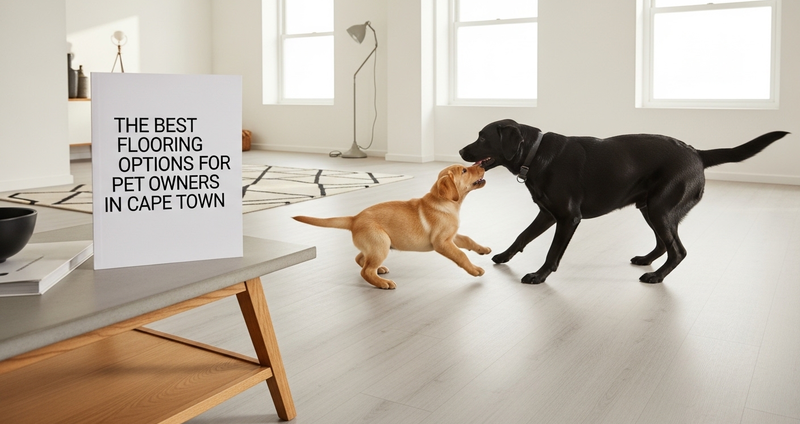
The Best Flooring Options for Pet Owners in Cape Town
If you share your home with dogs or cats in Cape Town, your floors are quietly losing a battle every single day. Flooring materials need to offer a balance of scratch resistance, waterproofing for accidents, and durability against claws.
Key Takeaways: Flooring Options for Pet Owners in Cape Town
-
-
- Vinyl tile, ceramic tiles, and epoxy flooring are the top three most durable and pet-friendly flooring options available to Cape Town homeowners.
- Scratch resistance, moisture resistance, and grip are the three non-negotiable features any flooring must have before it qualifies as truly pet-safe.
- Laminate flooring has one critical weakness around pets that most flooring guides won’t tell you — and it could cost you a full replacement.
- LT Cape Flooring is Cape Town’s leading flooring installation specialist, serving government, commercial, and private homeowners across the metro.
- Not all flooring marketed as “durable” is actually safe or comfortable for your pets — some popular choices can cause long-term joint damage in dogs and cats.
-
Claws, puddles, muddy paws, and the occasional accident add up fast — and most standard flooring simply wasn’t built for it. The good news is that the right flooring choice can handle everything your pets throw at it while still looking great. LT Cape Flooring has worked with countless Cape Town pet owners and understands exactly what works in real homes with real animals.
Cape Town Pet Owners, Your Floors Take a Beating
Cape Town homes face a unique combination of challenges. The coastal humidity, sandy soil tracked in from beaches like Muizenberg and Blouberg, and the active outdoor lifestyle many residents enjoy means pets are constantly moving between outside and inside. That cycle of wet paws, gritty claws, and high-traffic movement accelerates floor wear significantly compared to drier, less active environments.
Add to that the South African summer heat, which causes certain flooring materials to expand, contract, or warp — and you start to understand why choosing the right flooring from the start matters so much.
The Real Damage Pets Do to Floors
It’s not just the obvious scratches. Pets cause damage in multiple ways that compound over time. Dog nails — especially on larger breeds like Boerboels, Labradors, and German Shepherds that are popular across the Western Cape — act like sandpaper on softwood and laminate surfaces. Urine is particularly destructive because it seeps into seams and subfloors, causing swelling, staining, and permanent odour if the surface isn’t fully waterproof. Even repeated wet paw traffic introduces moisture into flooring joints that aren’t sealed.
Why Most Standard Flooring Fails Pet Owners
Standard flooring is designed and tested for human foot traffic — not four-legged, claw-equipped animals with unpredictable bladders. Hardwood floors, for example, look stunning but are highly porous and soft enough that a medium-sized dog’s nails will leave visible gouges within weeks. Even mid-grade laminate, which mimics the look of wood, has a thin wear layer that scratches easily and a core that swells permanently on contact with moisture.
The reality is that most flooring options are marketed based on aesthetics first and durability second. For pet owners, that prioritisation needs to flip entirely.
What Makes Flooring Truly Pet-Friendly
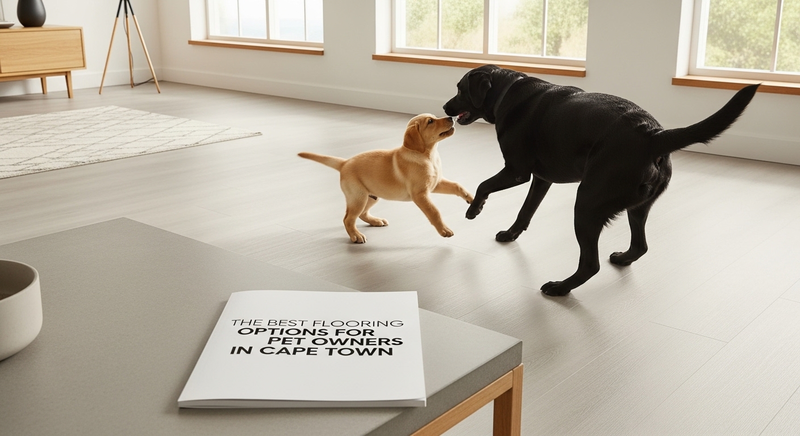
Before looking at specific materials, it helps to understand the four core properties that separate genuinely pet-friendly flooring from everything else. These aren’t marketing buzzwords — they’re functional requirements that directly affect how long your floor lasts and how safe and comfortable your pets are on it.
Scratch Resistance
Scratch resistance is measured by the Janka hardness rating for natural materials and by AC (Abrasion Class) ratings for laminates. For pet households, you want a Janka rating above 1,200 lbf for any timber-based product, or an AC4 rating minimum for laminate. Ceramic tile and vinyl are measured differently but are inherently harder than most wood products, making them naturally superior choices in this category.
-
-
- Ceramic tiles: Virtually scratch-proof under normal pet use
- Luxury vinyl tile (LVT): Resists surface scratches from dog and cat claws effectively
- AC4-rated laminate: Handles moderate scratch exposure but is not fully scratch-immune
- Solid hardwood: Scratches easily — requires frequent refinishing in pet homes
- Epoxy: Extremely hard surface with excellent scratch resistance
-
Moisture and Stain Resistance
This is arguably the most critical factor for pet owners. Urine, water bowl spills, and wet paws introduce moisture repeatedly over a floor’s lifetime. Any flooring with exposed seams, a porous surface, or a wood-based core is at serious risk of swelling, warping, or developing permanent staining and odour. Fully waterproof flooring — meaning waterproof all the way through, not just on the surface — is the gold standard for households with pets.
Vinyl sheet flooring is particularly strong here because it has zero seams across large areas, eliminating the entry points where moisture does the most damage. Ceramic tiles are also waterproof, though grout lines need to be properly sealed to prevent urine absorption.
Grip and Traction for Pets
This is one of the most overlooked factors — and it directly affects your pet’s health. Floors that are too slippery force dogs and cats to constantly tense and scramble to stabilise themselves, which over time contributes to hip dysplasia, joint stress, and ligament injuries. This is especially important for older pets and larger breeds. A textured or matte-finish surface provides significantly better traction than a high-gloss polished one, even if both are made from the same base material.
Ease of Cleaning
Daily life with pets means daily cleaning. The right flooring should be wipeable, mop-friendly, and resistant to the disinfectants and enzymatic cleaners used for pet accidents. Flooring with deep grout lines, rough textures that trap hair, or surfaces that react badly to cleaning chemicals will add significant maintenance burden over time. For more information on choosing the right flooring, visit LTCape Flooring.
-
-
- Smooth ceramic tiles: Easy to mop, but grout lines collect hair and need sealing
- Vinyl sheet and vinyl tile: Wipe-clean with standard mop, pet-safe cleaners won’t damage surface
- Epoxy: One of the easiest floors to clean — seamless and fully sealed
- Laminate: Surface cleans easily but cannot be wet-mopped without risking joint damage
-
1. Ceramic Tiles: The Hardest-Wearing Option
Ceramic tiles are one of the most popular flooring choices in South African homes — and for good reason. When it comes to pet households specifically, ceramic tile offers a combination of scratch resistance, waterproofing, and longevity that very few other materials can match at a comparable price point.
Why Ceramic Holds Up Against Claws and Accidents
Ceramic tiles are fired at extremely high temperatures during manufacturing, which produces a surface that is essentially impervious to pet claws. Even large, energetic dogs that sprint across the floor won’t leave marks on a properly glazed ceramic tile. The surface is also non-porous, meaning urine, water, and other pet-related liquids sit on top rather than absorbing in — giving you time to clean up accidents before any damage occurs.
The one area where ceramic requires attention is the grout. Standard unsealedgrout is porous and will absorb pet urine, leading to staining and persistent odour over time. The fix is straightforward: always use an epoxy-based grout or apply a quality grout sealer after installation. This single step transforms ceramic tile into a genuinely seamless, pet-proof surface that can last decades with minimal maintenance.
Best Rooms to Use Ceramic Tiles With Pets
Ceramic tiles work exceptionally well in high-traffic, high-mess areas of the home. Kitchens, laundry rooms, entryways, and bathrooms are ideal — these are the zones where wet paws, food spills, and accidents are most likely to happen. In Cape Town homes where pets frequently move between outdoor garden areas and indoor living spaces, a tiled entryway or mudroom acts as a practical transition zone that’s easy to hose down or mop.
One consideration worth noting is comfort. Ceramic tiles are hard underfoot and can feel cold during Cape Town’s winter months, particularly in areas like the Southern Suburbs and the Cape Peninsula where temperatures drop meaningfully at night. Placing pet beds and mats in resting zones gives your animals a comfortable spot without compromising the practicality of the tiled surface around them.
2. Vinyl Tile: Affordable, Tough, and Pet-Safe
Luxury vinyl tile — commonly referred to as LVT — has become one of the most recommended flooring options for pet owners globally, and Cape Town homes are no exception. It combines a realistic wood or stone aesthetic with a fully waterproof construction, making it one of the smartest value choices available for households with animals. Modern LVT products feature a rigid core construction with a wear layer measured in millimetres — for pet homes, look for a wear layer of at least 0.5mm (20 mil), which provides meaningful resistance against daily claw traffic.
How Vinyl Tile Handles Scratches and Spills
The wear layer on quality LVT acts as a sacrificial barrier between your pet’s claws and the decorative layer beneath. While no flooring is completely scratch-proof, a thick-wear-layer vinyl tile will resist the kind of surface marking that makes floors look aged and worn within a year or two of pet ownership. Spills — including urine — don’t penetrate the tile itself, and because LVT is 100% waterproof through its full thickness, there’s no risk of the core swelling or warping when moisture gets onto the surface.
Vinyl Tile vs. Vinyl Sheet: Which Is Better for Pets
Both are excellent choices, but the difference comes down to installation format. Vinyl tile is installed in individual pieces, which means there are seams between tiles. In most everyday situations, these seams are tight enough to prevent moisture from reaching the subfloor — but in households with frequent accidents or very wet conditions, those seams represent a vulnerability. Vinyl sheet, by contrast, is installed in large continuous sections with minimal or no seams across a room, which eliminates that risk almost entirely.
If your pet is young, still being housetrained, or has a known history of accidents, vinyl sheet is the more cautious choice. For pets that are fully trained and well-behaved, vinyl tile offers a slightly more premium aesthetic with the same core durability — and individual tiles can be replaced if one section gets damaged, which is a practical advantage vinyl sheet doesn’t offer.
3. Vinyl Sheet: Seamless Protection Against Pet Accidents
Vinyl sheet flooring is the closest thing to a worry-free solution for pet owners who prioritise accident protection above all else. Because it’s installed in large rolls — often covering an entire room with a single piece — there are no seams for urine to seep through, no joints that trap pet hair, and no gaps where odour-causing bacteria can settle. The surface cleans with a standard mop and mild detergent, and enzymatic pet cleaners work perfectly on it without causing surface damage. For Cape Town pet owners in rentals or homes where floor replacement is a concern, vinyl sheet is a particularly smart protective layer.
4. Laminate Flooring: Style Without Sacrificing Durability
Laminate flooring is worth considering for pet owners who want the warm, timber-look aesthetic without paying hardwood prices. High-quality laminate products — particularly those with an AC4 or AC5 abrasion rating — offer meaningful scratch resistance that holds up well against cat claws and the nails of small to medium dog breeds. The photographic layer beneath the wear surface can mimic oak, walnut, or pine convincingly, giving you the look of a premium timber floor at a fraction of the cost.
High-Density Laminate and Its Scratch Resistance
The key differentiator in pet-suitable laminate is the density of the core and the thickness of the wear layer. High-density fibreboard (HDF) cores are more dimensionally stable and harder than standard medium-density fibreboard (MDF) cores, meaning they resist both surface scratches and minor impact damage better. An AC4-rated laminate is designed for heavy commercial traffic, which translates to strong performance in an active pet household. Look for products with a wear layer of at least 0.4mm and an attached underlayer that provides cushioning — this also helps reduce the clicking sound of claws on the surface.
The One Weakness of Laminate Around Pets
Here’s what most flooring guides won’t tell you plainly: laminate flooring has a wood-based core, and that core is not waterproof. It never has been. Even products marketed as “water-resistant” laminate will swell, bubble, and delaminate if liquid — including pet urine — sits in the joints for more than a few minutes. Once the core swells, the damage is permanent and the affected boards must be replaced entirely. There is no refinishing option. For more information on suitable flooring options, visit Cape Flooring.
This doesn’t mean laminate is off the table for pet owners — it means it’s only suitable in the right context. If your pets are fully housetrained, you respond quickly to any accidents, and you’re installing in a lower-risk area like a bedroom or lounge rather than a kitchen or bathroom, laminate can work well. But in homes with puppies, older incontinent pets, or any animal with ongoing accident issues, the moisture vulnerability of laminate makes it a risky investment.
5. Epoxy Flooring: The Heavy-Duty Choice for Pet Owners
Epoxy flooring sits in a different category from everything else on this list. While vinyl, laminate, and ceramic are installed as pre-manufactured products, epoxy is a liquid coating system that’s applied directly onto a concrete subfloor and cures into a seamless, incredibly hard surface. This makes it uniquely suited to high-demand environments — and for the right Cape Town pet owner, it’s arguably the most durable option available at any price point.
Why Epoxy Is Almost Indestructible
Once cured, epoxy forms a surface that is harder than most natural stone and completely seamless from wall to wall. There are no joints, no grout lines, no seams — nothing for pet urine, water, or dirt to penetrate. The surface hardness means even the largest, most energetic dog breeds won’t scratch or dent it under normal conditions. It also bonds chemically to the concrete beneath it, meaning it won’t lift, peel, or shift the way adhesive-backed flooring products can over time.
Epoxy is also entirely customisable in terms of finish. A matte or anti-slip aggregate finish — which is strongly recommended for pet households — gives animals solid traction even when the floor is wet. High-gloss epoxy, while visually striking, becomes dangerously slippery when wet and should be avoided in homes with dogs or cats. The right finish makes all the difference between a floor that supports your pet’s joint health and one that causes daily stress on their hips and ligaments.
Where Epoxy Flooring Works Best in a Pet Home
Epoxy is best suited to garages, utility rooms, kennels, enclosed patios, and any dedicated pet area where hygiene and durability are the top priorities. It’s not the most common choice for main living areas because it lacks the warm, soft aesthetic that most homeowners want in bedrooms or lounges — but in functional spaces, it’s unmatched. Cape Town pet owners who keep large or multiple dogs, run home-based pet care, or simply want a zero-maintenance floor in a specific zone of the home will find epoxy delivers a return on investment that no other flooring type can rival.
Flooring to Avoid if You Have Pets
Just as important as knowing what works is knowing what to steer clear of. Several popular flooring options that look great in showrooms perform poorly — and sometimes dangerously — in pet households.
- Solid hardwood: Scratches within weeks from dog nails, absorbs urine permanently, and cannot be made waterproof without destroying its natural breathability.
- Engineered wood: More stable than solid hardwood but still has a real wood veneer that scratches and a wood-based core that swells with moisture exposure.
- High-gloss polished tiles: The gloss finish creates a slippery surface that forces pets to scramble for traction, contributing to joint strain and injury over time.
- Unsealed natural stone: Marble and granite are porous when unsealed and will absorb pet urine deeply, making odour removal extremely difficult.
- Standard carpet: Traps pet hair, dander, urine, and bacteria at a level that no amount of vacuuming fully resolves — and provides an ideal environment for fleas to breed.
The Best Pet-Friendly Flooring for Cape Town Homes
Every pet household is different, and the best flooring choice depends on your specific animals, your home layout, and your priorities. That said, the options covered in this guide can be ranked practically for most Cape Town situations:
| Flooring Type | Scratch Resistance | Waterproof | Pet Traction | Ease of Cleaning | Best For |
|---|---|---|---|---|---|
| Ceramic Tile (sealed grout) | Excellent | Yes | Good (matte finish) | Very Easy | Kitchens, entries, laundry |
| Vinyl Sheet | Good | Yes (seamless) | Good | Very Easy | Full rooms, accident-prone pets |
| Luxury Vinyl Tile (LVT) | Good–Very Good | Yes | Good | Easy | Living areas, bedrooms |
| Epoxy (anti-slip finish) | Excellent | Yes (seamless) | Excellent | Excellent | Garages, kennels, utility rooms |
| Laminate (AC4+) | Good | No | Moderate | Moderate | Low-risk areas, trained pets only |
For most Cape Town pet owners, luxury vinyl tile or ceramic tile with sealed grout will be the sweet spot — durable enough to handle daily pet activity, attractive enough for main living areas, and priced accessibly for the average home renovation budget. If you have multiple large dogs, a dedicated pet space, or a particularly high-traffic home, epoxy flooring for utility zones combined with LVT in living areas is an extremely effective combination.
FAQ’s About Flooring Options for Pet Owners in Cape Town
These are the questions Cape Town pet owners ask most often when choosing flooring — answered directly and without the usual marketing spin.
What is the most scratch-resistant flooring for dogs in Cape Town?
Ceramic tile and epoxy flooring are the most scratch-resistant options available. Both have surface hardness levels that exceed what any domestic dog’s claws can damage under normal conditions. Among installed-panel or plank-style flooring, luxury vinyl tile with a wear layer of 0.5mm or above offers the best scratch resistance, particularly for medium to large breeds like Boerboels, Rottweilers, and Labradors that are common across the Western Cape.
Is laminate flooring good for pets?
Laminate flooring can work for pets in the right situation — specifically, fully housetrained animals in low-moisture areas of the home. Its AC4-rated surface handles surface scratches reasonably well, and it’s available at a lower price point than vinyl or ceramic. However, its core is not waterproof, and any urine or standing liquid that reaches the seams will cause irreversible swelling and warping.
For households with puppies, older pets, or any animal with incontinence issues, laminate is a risk that usually ends in premature floor replacement. In those cases, vinyl or ceramic is a more cost-effective long-term decision.
Which flooring is easiest to clean after pet accidents?
Easiest to hardest to clean after pet accidents:
- Epoxy flooring — Fully seamless, wipe clean instantly, no absorption whatsoever
- Vinyl sheet — Seamless across the room, mop-clean in minutes, no penetration risk
- Ceramic tile (sealed grout) — Non-porous surface cleans easily; sealed grout prevents odour absorption
- Luxury vinyl tile — Cleans quickly but tight seams require immediate attention to prevent seepage
- Laminate — Surface wipes easily but seams must be dried immediately to prevent core damage
The key principle with any flooring and pet accidents is response time. Even the most waterproof surface becomes a problem if urine is left sitting long enough to work its way into any available gap or edge. Seamless flooring options — epoxy and vinyl sheet — remove that variable entirely by eliminating the gaps.
When cleaning pet accidents, always use an enzymatic cleaner rather than just soap and water. Enzymatic cleaners break down the uric acid crystals in pet urine that cause persistent odour — soap and water mask the smell temporarily but don’t neutralise the source. Products like Simple Solution or Bio-Zet Attack are effective and safe on all the flooring types listed in this guide.
Is epoxy flooring safe for pets?
Once fully cured, epoxy flooring is completely safe for pets. The curing process — which takes approximately 72 hours for a standard two-part epoxy system — involves off-gassing of chemical compounds that are harmful if inhaled during application and curing. During this window, pets and people should stay out of the treated space. After the full cure time has passed, the surface is chemically inert and poses no ongoing risk to animals.
One practical consideration is the finish. As mentioned earlier, a high-gloss epoxy surface becomes slippery when wet and is not recommended for pet households. Specifying a matte finish or requesting that anti-slip aggregate be added to the top coat during installation produces a surface that gives pets confident, stable footing — which is particularly important for senior dogs or breeds predisposed to hip problems.
What flooring gives pets the best grip and reduces joint strain?
Traction is directly tied to surface finish and texture rather than the material itself. A matte-finish ceramic tile provides far better grip than a polished porcelain tile made from the same base material. Similarly, a textured vinyl tile outperforms a smooth high-gloss version even if both carry identical waterproof ratings.
For dogs specifically, joint strain from slippery floors accumulates over time and can accelerate the development of conditions like hip dysplasia and cruciate ligament damage — issues that are already genetically predisposed in popular South African breeds including German Shepherds, Labradors, and Golden Retrievers. Choosing a floor with a coefficient of friction (COF) above 0.6 — which is the minimum slip-resistance standard for commercial wet areas — is a practical benchmark for pet-safe traction.
The flooring options that naturally meet or exceed this standard in their standard form include textured ceramic tile, anti-slip epoxy, and vinyl sheet or tile with an embossed surface finish. High-gloss ceramic, polished porcelain, and smooth high-gloss vinyl all fall below this threshold when wet and should be avoided in homes with animals.
If you’ve already installed a slippery floor and aren’t ready to replace it, anti-slip mats placed in the areas your pet moves through most frequently — hallways, near food and water bowls, and at the base of stairs — provide meaningful short-term protection while you plan a longer-term flooring upgrade.
LT Cape Flooring specialises in professional flooring installation across the Cape Town metro, helping pet owners find the right solution for their home and their animals — get in touch to discuss your options.
- By: LTCape Admin" >LTCape Admin
- Tags: allergy safe flooring options, best pet friendly floors Cape Town, durable flooring for pet traffic, easy to clean floors for pets, flooring for homes with dogs, laminate flooring for Cape Town homes, non slip floors for pets South Africa, scratch proof vinyl plank South Africa, tile vs vinyl for pets, waterproof flooring for dog owners
- Category: pet friendly flooring Cape Town
- 0 comment
Leave a Reply