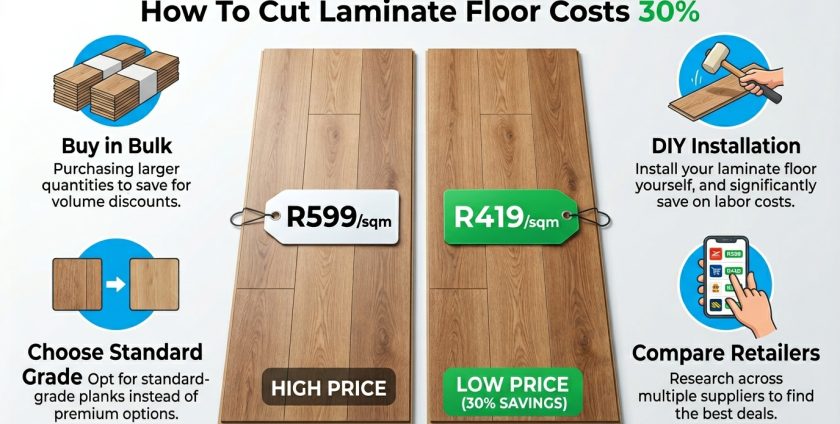
Cut Laminate Floor Costs 30% In Green Point
Most homeowners in Green Point walk away from their laminate flooring project having paid more than they should — not because they were ripped off, but because they didn’t know what to ask. LTCape Flooring works across the Cape Town Metropole and consistently helps clients avoid the costly mistakes that inflate final invoices.
The good news? A concerted attempt to cut laminate floor cost 30%, is absolutely achievable when you know where the money actually goes.
Key Takeaways: Cut Laminate Floor Costs 30% in Green Point
- Laminate flooring in Green Point costs between R300 and R800 per sqm installed — but most homeowners pay more than they need to.
- Getting 3 to 5 competitive quotes is the single most effective way to cut your laminate floor costs by up to 30%.
- Hidden costs like underlay, edging, and old floor removal can add hundreds to your bill if you don’t ask upfront.
- Letting your contractor supply materials directly often reduces markup costs significantly compared to sourcing them yourself.
- Timing your installation outside peak renovation season and knowing the red flags in low-ball quotes can protect your wallet — keep reading to find out exactly how.
Laminate Flooring in Green Point Costs More Than It Should
Green Point sits in one of Cape Town’s most desirable urban zones, and contractors know it. Labour rates, travel time, and demand all push quotes higher in this suburb compared to areas like Grassy Park or Bellville. That doesn’t mean you’re stuck paying a premium — it means you need to be sharper when evaluating quotes.
The difference between the cheapest and most expensive quote for an identical laminate job in Cape Town can be tens of thousands of rands. For an 80 sqm installation, real project data shows quotes ranging from R24,000 to well above R35,000 for comparable scopes of work. That spread is not random — it reflects contractor overheads, material markups, and in some cases, inflated margins on unsuspecting homeowners.
Understanding where your money goes is the first step to keeping more of it.
What Laminate Flooring Actually Costs in Green Point
Before you can cut costs, you need a clear picture of the actual numbers. Laminate flooring pricing in Cape Town follows a relatively consistent structure, but the total figure depends heavily on the size of the space, the condition of the existing floor, and whether the contractor is supplying materials or just providing labour.
Laminate Flooring Installation Rates: R300 – R800/sqm
The standard installed rate for laminate flooring in Cape Town — including Green Point — runs between R300 and R800 per sqm. This is an all-in figure that typically covers both the material and the labour. For a 33 sqm job covering two bedrooms, a passage, and a lounge, that puts your estimated range at roughly R9,900 to R26,400. The wide range exists because laminate boards vary significantly in quality, thickness, and finish — and contractors price accordingly.
Labour Costs Run R88 – R300/sqm Separately
When a contractor quotes for labour only — meaning you supply the boards yourself — expect to pay between R88 and R300 per sqm for installation. A real example: a 25 sqm job in Cape Town with the homeowner supplying materials came in at R6,500, which works out to R260/sqm for labour alone. This is important to know because it tells you exactly what the installation markup looks like when a contractor bundles material and labour into a single rate.
Why Green Point Quotes Run Higher Than Cape Town Suburbs
Contractors working in Green Point and the Atlantic Seaboard factor in higher operational costs — parking, travel, and the expectation that clients in premium suburbs will accept higher rates without pushback. A flooring job in Beacon Bay quoted at R75,000 for 150 sqm works out to R500/sqm. That same rate applied to a 33 sqm Green Point apartment puts you at R16,500 before any extras. Knowing the per-sqm benchmarks gives you negotiating leverage that most homeowners simply don’t have.
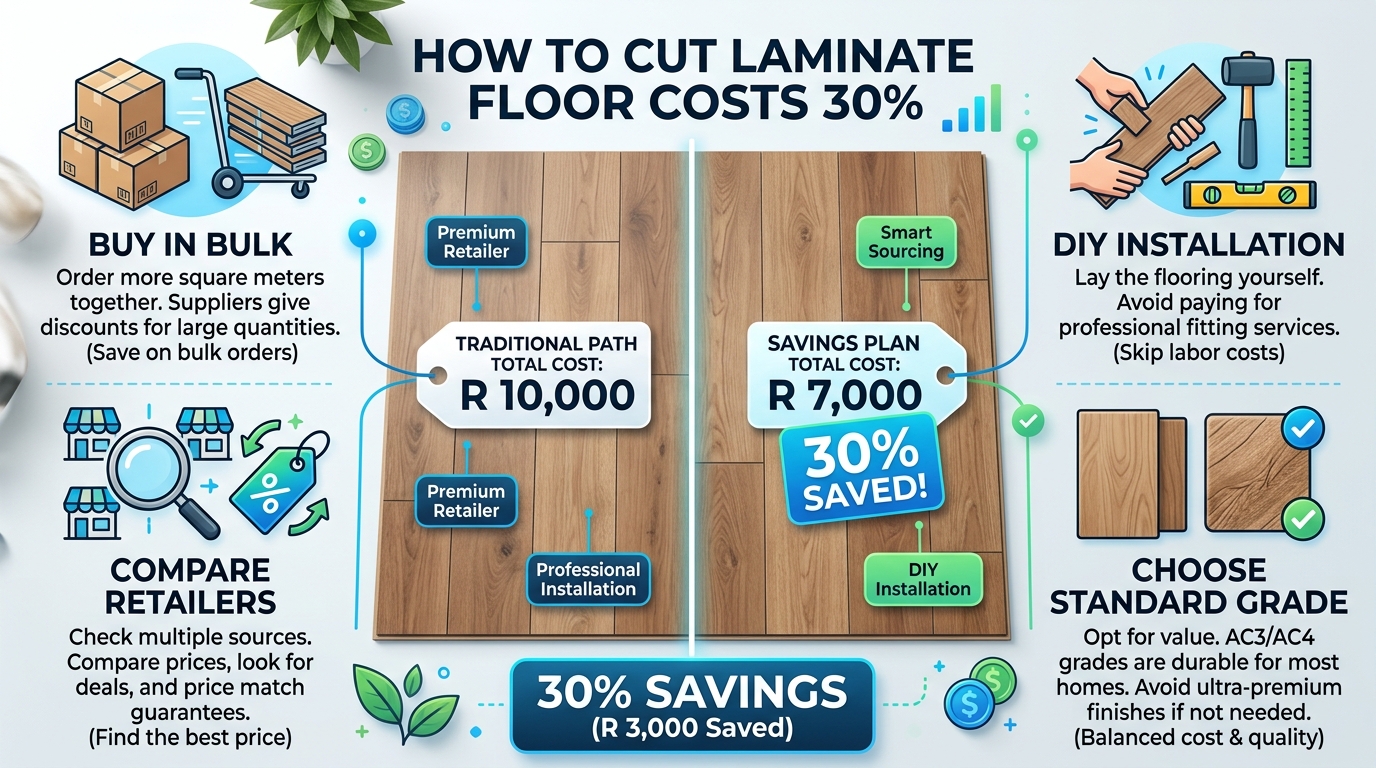
The 30% Saving Is Real — Here Is How It Works
To cut laminate floor costs 30%, isn’t about finding a dodgy contractor willing to cut corners. It’s about making three specific decisions before the work even starts.
Compare at Least 3 to 5 Quotes Before Committing
This is the single highest-return action you can take. Real project data from Cape Town homeowners consistently shows that the first quote is rarely the best one. One homeowner received five quotes for a laminate installation and selected a professional contractor after comparing all of them — and the contractor completed the job efficiently and to a high standard.
The spread between quotes on identical jobs is often 20 to 40%. On a R20,000 job, that’s R4,000 to R8,000 left on the table if you accept the first number you’re given. Three quotes is the minimum. Five gives you a much clearer picture of what the market rate actually is.
Ask Pros to Supply Materials Directly to Cut Markup Costs
There’s a common assumption that sourcing your own boards saves money. In practice, it often doesn’t — unless you have direct access to a trade supplier. Contractors who supply materials regularly buy at trade pricing that individual homeowners can’t access. When you ask the contractor to supply and install, you eliminate the retail margin you’d pay at a flooring store, and the contractor’s own markup is often competitive because they’re moving volume.
The key is to ask the contractor to itemise the quote — separating the material cost from the labour cost. This one request immediately tells you whether the material markup is reasonable or inflated. A contractor unwilling to break down the quote is a red flag worth noting.
- Always request an itemised quote showing materials and labour separately
- Ask what brand and thickness of laminate board is included in the price
- Confirm whether underlay is included or quoted separately
- Check if edging strips and transition pieces are in the quote
- Clarify whether old floor removal (carpet, tiles) is included or an additional charge
Time Your Installation Outside Peak Renovation Season
Cape Town’s renovation season peaks between October and February, when the weather is dry and homeowners are preparing properties for summer. During this window, contractors are in high demand, lead times stretch out, and pricing reflects that pressure. Booking your laminate installation between March and July — the quieter autumn and winter months — gives you real negotiating leverage.
Contractors who are less busy are more willing to sharpen their pencils on price to secure work. A job that costs R18,000 in November might come in at R14,500 to R15,500 in June for the exact same scope. That’s a meaningful saving simply from choosing the right time to call.
Where Most Homeowners Overpay Without Realising It
The quoted rate per sqm is only part of the story. Where most Green Point homeowners get caught out is in the line items that don’t appear in the headline number — the extras that get added once the job is underway or confirmed. These aren’t always dishonest additions; sometimes they’re genuinely overlooked. But knowing about them in advance puts you in control.
A flooring quote that looks competitive at R400/sqm can quietly become R550/sqm once underlay, edging, waste material, and old floor removal are factored in. On a 33 sqm job, that difference adds up to over R4,900 in unexpected costs. The fix is straightforward: ask every question before you sign anything.
Hidden Costs: Underlay, Edging, and Waste Allowance
Underlay is not optional — it’s required under laminate flooring to provide cushioning, reduce noise, and protect the boards from moisture. Yet many quotes leave it out entirely, or mention it only in fine print. Standard underlay adds roughly R30 to R80 per sqm to the total cost depending on the thickness and type specified.
- Underlay: R30 – R80/sqm, often excluded from headline quotes
- Edging strips and transitions: Priced per linear metre, required at doorways, stairs, and room boundaries
- Waste allowance: Typically 10% extra material ordered to account for cuts — this adds directly to material cost
- Beading and skirting: Sometimes included, sometimes a separate line item — always confirm
- Levelling compound: Required if the subfloor is uneven — this can add significantly to labour time and cost
Edging strips are easy to overlook but add up fast in apartments with multiple doorways and room transitions. A typical Green Point apartment with four doorways and a kitchen transition could require 8 to 12 linear metres of edging at R80 to R150 per metre — that’s up to R1,800 that never appeared in the original quote.
The 10% waste allowance is industry standard and completely legitimate. The problem arises when contractors order significantly more than needed and charge you for the surplus without returning unused boards. Always ask what happens to leftover material — you paid for it, and it belongs to you.
Carpet and Tile Removal Fees That Inflate Final Bills
Removing old flooring before laminate can be installed is a labour-intensive step that many homeowners forget to budget for. Real project examples from Cape Town show this scope appearing repeatedly: carpet removal in two bedrooms, tile removal in a lounge and passage — all before a single laminate board is laid.
Carpet removal is generally the cheaper option, typically charged per sqm or as a flat fee depending on the area. Tile removal is considerably more labour-intensive — tiles are bonded to the substrate and often require grinding or chiselling, which takes time and can damage the subfloor beneath. If the subfloor is damaged during tile removal, levelling compound becomes necessary, adding another cost layer entirely.
Disposal is a separate question. Some contractors include rubble removal in their quote; others treat it as an additional charge. A full tile and carpet removal job for a 33 sqm space can add R2,000 to R5,000 to your final invoice if it’s not scoped upfront. Get it in writing before the job starts.
How to Choose the Right Green Point Laminate Flooring Pro
Price matters, but it’s not the only thing that matters. The cheapest contractor on your list can easily become the most expensive one if the job is done poorly — re-installation costs, board replacements, and subfloor repairs can dwarf the original saving. The right contractor is the one who delivers quality work at a fair, transparent price.
In Green Point specifically, you’re working with a mix of older apartment buildings and newer developments. Both present specific challenges: older buildings often have uneven concrete subfloors that need levelling, while newer builds may have specific body corporate requirements around flooring types and underlay specifications for sound insulation. A contractor with local experience understands these variables before they become problems.
The best approach is to verify credentials, check real reviews from completed jobs, and assess how a contractor communicates before you commit. How they handle your questions during the quoting process is a reliable preview of how they’ll handle issues during the job.
Verified Pros vs. Unverified Contractors: The Risk Difference
Verified contractors — those who have been vetted through a platform, carry valid insurance, and have documented reviews from real completed jobs — offer a layer of accountability that informal referrals and social media listings simply can’t match. When something goes wrong with an unverified contractor, your recourse is limited. When it goes wrong with a verified pro, there’s a process to follow and a reputation on the line.
The risk isn’t just financial. Poor laminate installation — boards that lift, gaps that appear, or moisture damage from improper underlay — can render the entire floor unusable within months. The cost of a second installation wipes out any saving from the cheaper original quote. Verified, reviewed professionals consistently deliver better long-term value even when their upfront price isn’t the lowest.
What a Professional Quote Should Always Include
A professional laminate flooring quote is a document, not a number. Any contractor who gives you a verbal price or a single-line invoice is leaving room for disputes, additions, and misunderstandings that will cost you money. A proper written quote gives you a clear scope of work and protects both parties.
The quote should clearly state the total sqm being covered, the laminate board brand and specification (thickness in mm, AC wear rating), underlay type and thickness, all edging and transition pieces, and whether old floor removal and disposal are included. Payment terms and an estimated completion timeline should also be present.
If a contractor submits a quote that’s missing these details, don’t reject them outright — ask them to revise it. A professional will comply without issue. One who resists or becomes evasive about specifics is telling you something important about how the job will be managed.
What a Complete Laminate Flooring Quote Should Include:
✅ Total sqm to be covered
✅ Laminate board brand, thickness (mm), and AC wear rating
✅ Underlay type and thickness specified
✅ Edging strips and transition pieces itemised
✅ Old floor removal — included or excluded, clearly stated
✅ Rubble and waste disposal — included or excluded
✅ Subfloor levelling — flagged if required, costed separately
✅ Payment terms and deposit amount
✅ Estimated start date and completion timeline
✅ Contractor’s contact details, VAT number if applicable, and warranty terms
Red Flags to Watch for in Low-Ball Quotes
A quote that comes in significantly below every other price you’ve received deserves scrutiny, not celebration. Low-ball quotes typically signal one of three things: the contractor has left out key line items and will add them back later, the materials specified are substandard, or the labour will be rushed and unsupervised. In all three cases, you end up paying more — either through hidden additions during the job or through a floor that needs remediation within a year.
Laminate vs. Vinyl: Which Saves You More in Green Point
Both laminate and vinyl flooring are popular choices in Cape Town apartments, and the decision between them has a direct impact on your total project cost. They look similar at a glance, but they behave very differently — and in a coastal suburb like Green Point, those differences matter more than most homeowners realise.
Laminate is a wood-fibre core product with a photographic layer and a protective wear coat. It looks great, handles foot traffic well, and costs less per sqm than engineered timber — but it doesn’t tolerate moisture. Green Point’s proximity to the ocean means humidity levels are consistently higher than inland suburbs. Bathrooms, kitchens, and any room with exposure to damp air are risk environments for standard laminate. Vinyl, by contrast — particularly luxury vinyl plank (LVP) — is 100% waterproof and handles Cape Town’s coastal humidity without warping or swelling.
On pure material cost, standard laminate boards typically come in cheaper than LVP at the entry level. However, mid-range LVP and mid-range laminate often land in a similar price band once underlay and installation are factored in. Where laminate loses ground in Green Point specifically is in longevity — a laminate floor installed without adequate moisture management in a coastal apartment may need replacement in 5 to 8 years, while quality LVP in the same environment routinely lasts 15 to 20 years. The cheaper upfront option isn’t always the cheaper long-term one.
Getting the Best Deal Starts With the Right Quote
Every rand you save on laminate flooring in Green Point comes down to one thing: how well you shop for your quote. Get at least three to five quotes, insist on itemised breakdowns, ask about all potential extras upfront, and time your installation outside peak season. These four moves alone can realistically reduce your final invoice by 25 to 30% without compromising on quality, materials, or workmanship.
FAQ’s About How To Cut Laminate Floor Costs 30%
Here are the most common questions Green Point homeowners ask before starting a laminate flooring project — with straight answers based on real Cape Town pricing and project data.
What Is the Average Cost of Laminate Flooring Installation in Green Point, Cape Town?
The average cost of laminate flooring installation in Green Point runs between R300 and R800 per sqm for a fully installed rate that includes materials and labour. For a typical apartment covering two bedrooms, a passage, and a lounge — roughly 33 to 35 sqm — expect to budget between R9,900 and R26,400 depending on the quality of boards selected and the contractor’s rates.
Green Point tends to sit toward the upper end of the Cape Town pricing range due to higher contractor overheads and demand in the area. Labour-only rates — where you supply the boards — run separately at R88 to R300 per sqm. Always request an itemised quote to understand exactly what you’re paying for before committing.
Should I Supply My Own Laminate Flooring or Let the Pro Supply It?
In most cases, letting a verified contractor supply the laminate boards works out to be equally cost-effective or cheaper than buying retail yourself — provided you ask for an itemised quote so you can see the material cost clearly. Contractors who regularly install flooring buy at trade pricing that individual homeowners can’t access through standard retail channels. That trade discount often offsets or eliminates any markup they apply.
Where supplying your own material makes sense is if you have direct access to a trade supplier or have already sourced a specific board at a price you know is competitive. In that case, get a labour-only quote and compare. The key is never to assume one approach is cheaper — always run the numbers on both options before deciding.
How Many Quotes Should I Get Before Hiring a Laminate Flooring Pro?
Get a minimum of three quotes, but aim for five if your project is larger than 30 sqm. The first quote sets a reference point; the second and third reveal the range; the fourth and fifth start to show you the true market rate with enough confidence to negotiate. Real Cape Town homeowners who followed this approach — like one who received five quotes for a laminate installation — consistently reported selecting better contractors at better prices than those who accepted the first or second offer.
- Three quotes is the absolute minimum for any laminate job
- Five quotes gives you genuine market-rate confidence for projects above 30 sqm
- Always compare quotes for identical scopes — same sqm, same extras, same materials
- Don’t automatically choose the cheapest; look for the best value with full scope included
- Use the quotes you’ve gathered as leverage when negotiating with your preferred contractor
One critical point: compare quotes on an apples-to-apples basis. A quote at R350/sqm that includes underlay, edging, and old carpet removal is almost always better value than a quote at R280/sqm that excludes all three. Build a simple comparison table with every line item before making your final decision.
Does Removing Old Carpet or Tiles Add to the Laminate Installation Cost?
Yes — and it’s one of the most commonly overlooked cost additions in Cape Town flooring projects. Old carpet removal is the more affordable option, typically charged as a flat fee or per sqm rate depending on the area involved. Tile removal is significantly more expensive because tiles are bonded to the substrate and require manual chiselling or grinding to remove, which is labour-intensive and time-consuming.
For a 33 sqm space combining carpet in bedrooms and tiles in a lounge and passage — a setup that appears frequently in Green Point apartment projects — old floor removal and disposal can add R2,000 to R5,000 to the final invoice. If tile removal damages the subfloor, levelling compound becomes necessary before laminate can be laid, adding a further cost. Always ask your contractor to scope old floor removal explicitly in the quote, with disposal included, so this figure never appears as a surprise line item.
Is Laminate Flooring a Good Choice for Cape Town’s Coastal Climate?
Standard laminate flooring can work well in Green Point — but it requires careful selection and proper installation. The coastal humidity in Green Point is meaningfully higher than inland Cape Town suburbs, and laminate’s wood-fibre core is sensitive to prolonged moisture exposure. Boards that swell, lift, or gap are almost always the result of either moisture ingress from below or ambient humidity that the product wasn’t rated to handle.
The solution is twofold: first, select a laminate board with an AC4 or AC5 wear rating and a moisture-resistant core where possible; second, ensure a quality vapour barrier underlay is installed beneath the boards. These two steps significantly extend the lifespan of laminate flooring in a coastal environment.
For rooms with direct water exposure — bathrooms and kitchens — laminate is not recommended regardless of the product spec. Luxury vinyl plank (LVP) is the better choice in those spaces. For living areas, bedrooms, and passages in a Green Point apartment, a correctly specified and installed laminate floor will perform well and deliver strong value for money.
The bottom line: laminate in Green Point is a smart choice when you pick the right product and work with a contractor who understands coastal installation requirements. Cut corners on either and you’ll be replacing the floor sooner than you planned — which is the most expensive outcome of all.
LTCape Flooring specialises in flooring installation across the Cape Town Metropole and can help you get the right product, at the right price, installed correctly the first time.
- By: LTCape Admin" >LTCape Admin
- Tags: cost of laminate flooring per square metre, How much do laminate floor fitters charge per m2?, how much does it cost to install laminate flooring in Cape Town, how much does laminate flooring cost in Cape Town, how much is laminate floor per square meter, how much laminate flooring in a box, How to calculate the cost of laminate flooring?, How to cut cheap laminate flooring?, How to measure cuts for laminate flooring?
- Category: Affordable Flooring Installation Cape Town
- 0 comment

Leave a Reply